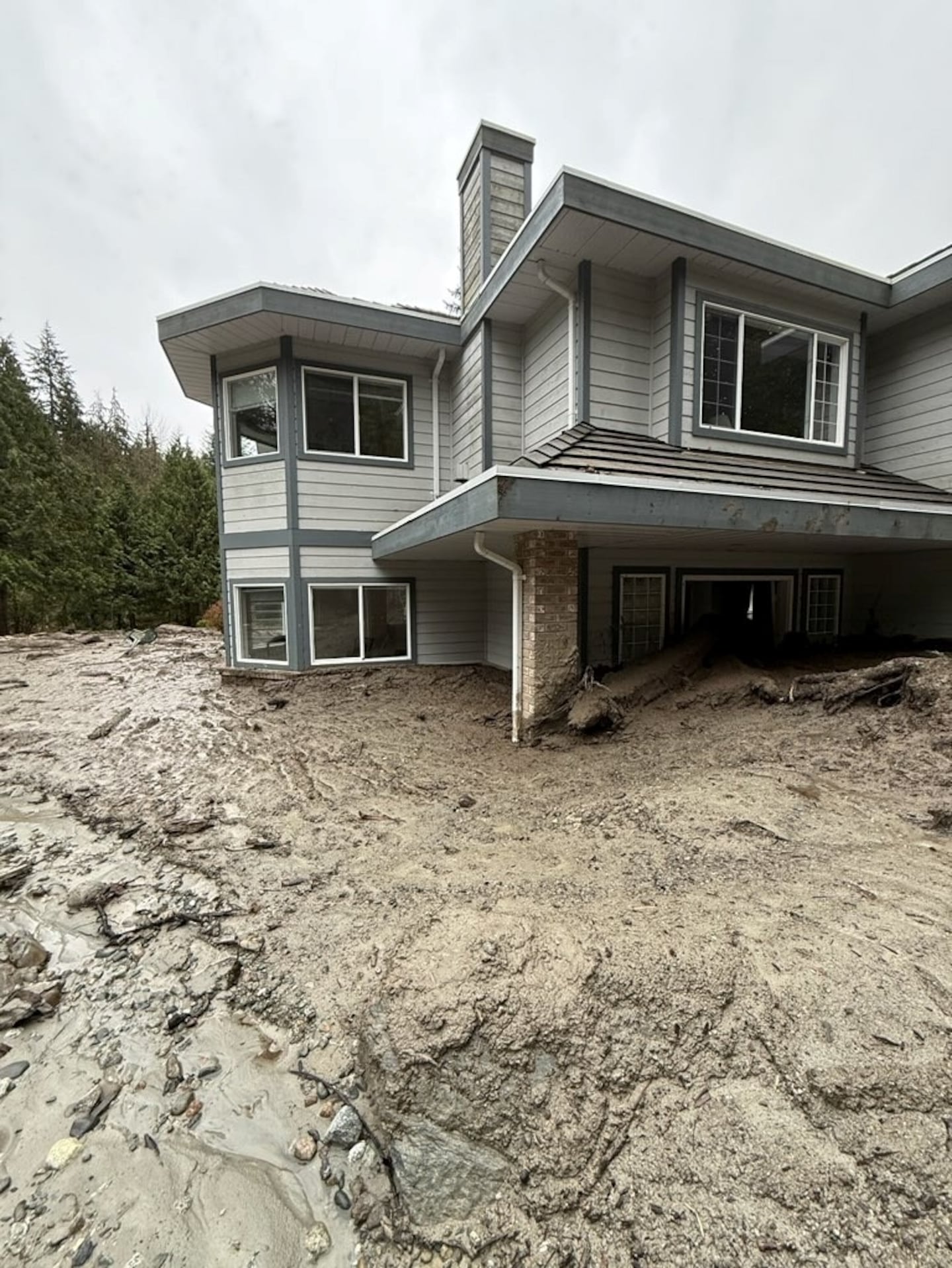
An elderly couple whose house was hit by a mudslide in Coquitlam, B.C., last month is still out of their home. But even as the repair costs continue to climb, what’s more worrisome to them is what the city’s initial review of the landslide says about their property. Tom Dmytronetz, who is 90, and his wife, Eileen Dmytronetz, who is 88, were sleeping when heavy rains triggered a mudslide that roared right into their house March 19. “It was terrible. My beautiful little desk was covered with mud, (there was) a hole in the wall,” recalled Eileen. The slide crashed through the doors of the couple’s house, leaving mud as high as four feet deep some places inside. “My husband found a tree in the front entrance. And there was a log that made its way in the front entrance and then underneath the stairs,” recalled Jeannie Dmytronetz, the couple’s daughter-in-law. The seniors were among the residents of five properties airlifted to safety after the slide shut down Pipeline Road. The couple has since learned their insurance doesn’t cover mudslides and they aren’t eligible for provincial disaster financial assistance. “While impacts were localized and meaningful to those affected, the physical damage from this event does not meet the threshold for broad or extensive damage required under DFA (Disaster Financial Assistance) policy,” reads an email from the Ministry of Emergency Management and Climate Readiness. Despite family and friends doing most of the repair work, the seniors will still be out tens of thousands of dollars to cover costs. “At this time of their lives, it’s a lot of money,” said their daughter-in-law. But repair costs may not be the biggest obstacle they face. A preliminary geotechnical report for the City of Coquitlam, considered an initial emergency assessment to ensure safety, found that their home would be “unsafe to reoccupy …without protective works in place to mitigate the risk.” “They did say uninhabitable, but if you read later on it says uninhabitable with conditions,” explained Jeannie. She said the conditions are that “if there’s a lot of rainfall that they have to be diligent about leaving.” In a statement from the city, Jaime Boan, general manager of engineering and public works, said the results of the geotechnical report determined the slide originated within “an undisturbed area of the Fulawka Creek catchment on Crown provincial land.” The city indicates the province will be able to advise on next steps to evaluate, control and monitor risk in the area. The Ministry of Emergency Management and Climate Readiness said it supported Coquitlam to undertake emergency works following the landslide. The Ministry of Water, Land and Resource Stewardship said in an email to CTV News that it provides funding for disaster mitigation projects, but didn’t specify what, if anything, will be done in this area. None of this is reassuring to Tom and Eileen, who have lived on their property for three decades, but still don’t know when they can return home. “It wasn’t our mud. It didn’t come from our land,” Eileen said. The couple has been staying next door with their son and daughter-in-law, who are also concerned about future mudslides hitting their own home. “(We’re) really worried. Something has to be done or else it will be unsafe for all of us to be here. Not just them, but all of us,” Jeannie said. She explained that for decades there had been no problems, but that in the last nine years, there have been three slides, the last one being the most serious. They’re concerned about creek diversions that have occurred upstream and are referenced in the city’s report. The province has said one of the diversions needs to be removed, according to the city’s report. The Dmytronetz family says it’s time for someone to tak
|